



A beach house is the only kind of house actively attacked by its own view. Salt, ultraviolet light, wind-borne sand and humidity work on every surface, every day, and they are entirely indifferent to how the room looked on handover. Designing one well in Baja California Sur means accepting that constraint first, then making something beautiful inside it — a more interesting problem than it sounds.
This is how the studio approaches beach house interior design on the Pacific side of Baja: what the climate actually does, which materials survive it, and how a house can open itself to the ocean without being worn out by it.
What a beach house has to survive
Three forces do most of the damage, and they compound. Salt aerosol settles on everything within a few hundred metres of surf and pulls moisture out of the air onto metal and fabric. Ultraviolet light at this latitude is relentless and fades dye, chalks finishes and embrittles plastics far faster than inland sun. Wind carries fine sand that abrades soft finishes and finds every gap in a detail.
None of this is a reason to build a bunker. It is a reason to make decisions in a particular order — envelope and material first, then furniture, then the soft layer that can be replaced without regret.
Materials that hold up, and what to avoid
The materials that age well here are the ones that were already local: lime plaster, unsealed or lightly sealed stone, solid hardwood, clay, brick, plaster over block. They weather rather than fail. A lime-plastered wall that picks up a patina after five seasons reads as character; a painted gypsum wall that blisters reads as neglect.
What struggles is anything that depends on a thin protective coating to survive — mild steel with a decorative finish, veneered panels in humid rooms, low-grade hardware, and foam-backed upholstery in a room that is open to the air. Marine-grade stainless, solid brass left to patinate, powder-coated aluminium and outdoor-rated performance textiles cost more once and less thereafter.
Timber deserves particular thought. Tropical hardwoods handle the coast well and grey gracefully if left unfinished, but a house that greys everywhere at once can look tired. We usually let exterior timber go silver and keep interior timber oiled, so the transition from outside to inside carries a deliberate change in tone.
Indoor and outdoor as one plan
The good Baja houses do not have an inside and an outside connected by a door. They have a sequence of increasingly sheltered rooms — open terrace, shaded loggia, deep-reveal interior — and the furniture plan reflects that. The most-used seat in the house is almost never in the living room; it is under cover, out of wind, with a view.
Designing that sequence properly means placing shade before glazing. A large opening with no overhang gives you glare, heat gain and a room nobody sits in between eleven and four. The same opening with a generous roof projection or a planted pergola becomes the best space on the plot.
Light, shade and the Pacific
Light on this coast is very bright and very white, and it flattens colour through the middle of the day. Interiors that look subtle on a mood board can read as washed-out on site. The usual correction is contrast: deeper wall colours than feel comfortable on paper, shaded corners left genuinely dark, and texture that catches a raking light in the late afternoon.
Thick walls help here as they always have. Deep window reveals cut glare, moderate temperature swing and frame the view rather than presenting all of it at once — a restraint that makes the sea more affecting, not less.
Furnishing for salt air
Upholstery is where beach houses are won and lost. Solution-dyed acrylics and outdoor-rated linens hold colour under UV in a way that indoor fabrics simply do not, and they now come in weights and weaves that no longer announce themselves as outdoor cloth. Loose covers that can be washed are worth the specification effort on any seat within reach of open air.
For frames, prefer solid joinery over ply and mechanical fixings over glue. Anything that will spend its life partly outdoors should be repairable in the town where it lives — which is an argument for locally made furniture on practical grounds, before any argument about provenance.
Palette: desert meeting ocean
Baja is not a tropical palette. It is a desert that ends at the Pacific — cardón, granite, sand, dry grass, and a very particular blue. Interiors that borrow from the immediate landscape rather than from a generic coastal idea sit far better in it: warm off-whites and plaster tones, clay and terracotta, unbleached fibre, and blues used sparingly enough to still mean something.
The temptation is nautical shorthand — navy stripes, rope, driftwood. It rarely survives contact with an actual Baja landscape, which is arid, mineral and much warmer in tone than the reference images suggest.
Where beach house interiors go wrong
Four failures recur. Specifying indoor furniture for covered outdoor rooms, which looks correct for one season. Glazing without shading, which produces rooms that are unusable at the best time of day. Choosing finishes that require constant maintenance in a house occupied part of the year. And over-committing to a coastal theme rather than to the place itself.
The last is the most expensive to undo, because it is embedded in joinery and tile rather than in cushions.
From the studio: beach houses in Baja
At Paros House in Todos Santos, the owners arrived with a photograph of Paros, Greece and a piece of land, and asked for Cycladic calm blended with Baja. Every piece of furniture and every material was made in Baja California Sur, a sustainability commitment written into the brief itself — three bedrooms, a guest casita and a rooftop for sunsets.
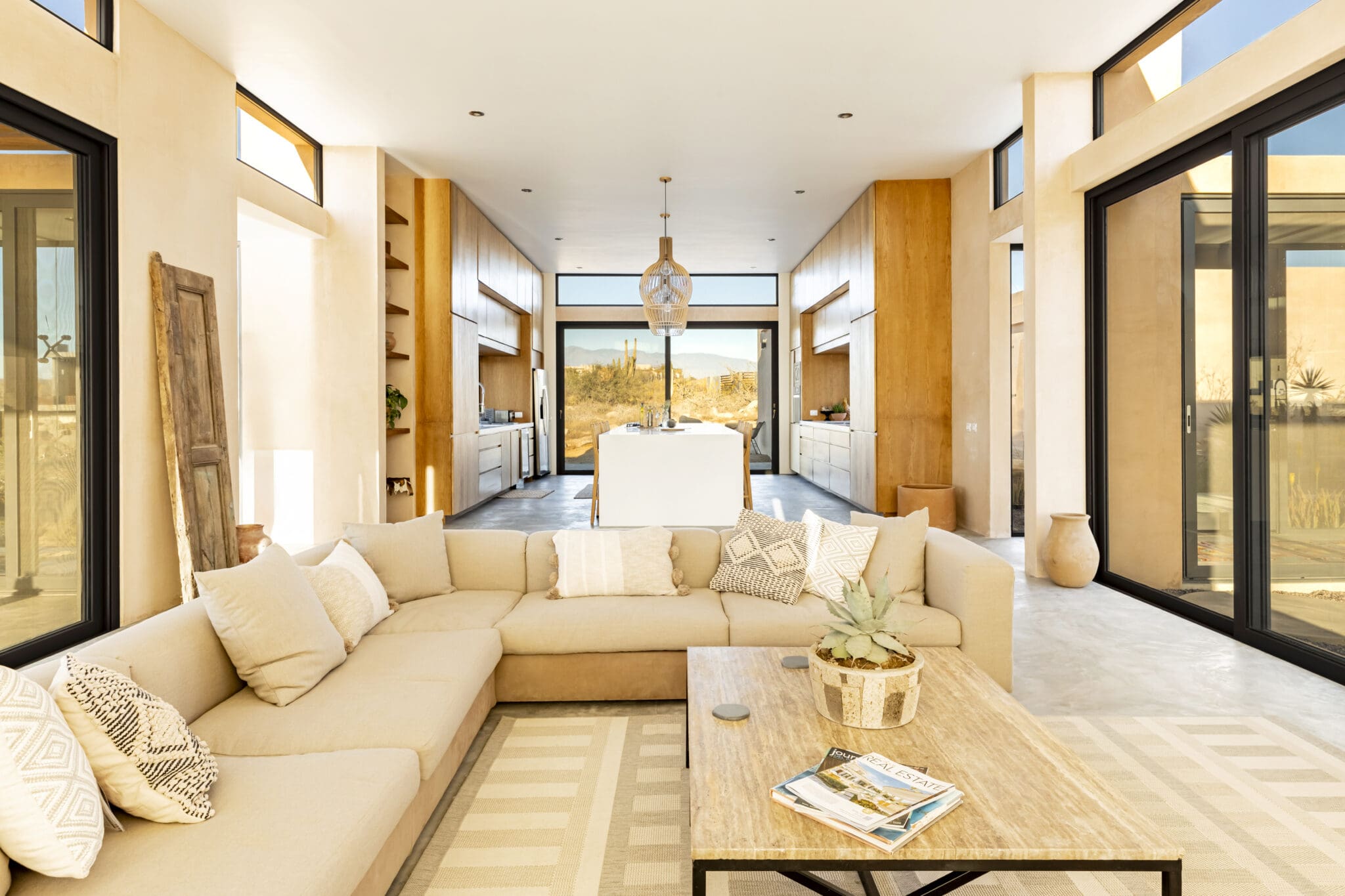
Canto Pacífico, in Las Tunas outside Todos Santos, is a new-build villa on the side of the arroyo with mountain and ocean views, where the interior, cabinetry and finishes were developed with architect Gaddo Piazzesi toward a distinctly Italian result. Gavilán Hilltop sits on the ridgeline in Pescadero, a five-bedroom villa overlooking the Pacific where the work was to draw the big views into generous gathering spaces while building warmth back in.
Casa Blanca Sur is the outlier and the most instructive: a property built in 2001 above one of Baja’s best surf breaks at Cerritos, left unused for four years, then brought back through a full gut renovation drawing on Moroccan influence, Mexican haciendas and 1970s Malibu surf hotels.
Planning a beach house in Baja
If you are building or renovating on this coast, the earlier the interior conversation starts, the more of it can be solved in architecture rather than in decoration. Explore the studio’s luxury residential design work, read how we think about Mexican interior design, see where we work in Todos Santos and Los Cabos, or start a conversation.